✦ Arabic – Course Details
The Best Online Arabic Language Course with Native Tutors
Master Quranic and conversational Arabic through interactive online Arabic classes designed for beginners, kids, and adults. Learn reading, writing, speaking, and understanding Arabic with qualified native tutors from the comfort of your home.
- One-to-one online Arabic lessons for all levels
- Native Arabic teachers with fluent English communication
- Learn Quranic Arabic, grammar, vocabulary, and conversation skills
No credit card required
500+
Students
Avg Rating
Certified
What Students Say About Our Arabic Course
Do you want to understand what you read in the Qur'an and Salah?
Understand the Qur'an in Arabic
Go beyond translation and understand the meanings of the verses and supplications you recite daily.
Structured learning for every level
Complete beginner or already know some Arabic, our curriculum guides you step by step toward fluency.
Learn from native Arabic teachers
Experienced native Arabic-speaking teachers who specialize in teaching both children and adults.
Personalized progress and certification
Regular progress reports, a customized learning plan, and a certificate upon completing each level.
Course overview
Arabic Language Course
- 500+ students enrolled worldwide
- Serving 42+ countries - UK, USA, Canada & more
- Certificate of completion included
- 5.0 rating on Trustpilot
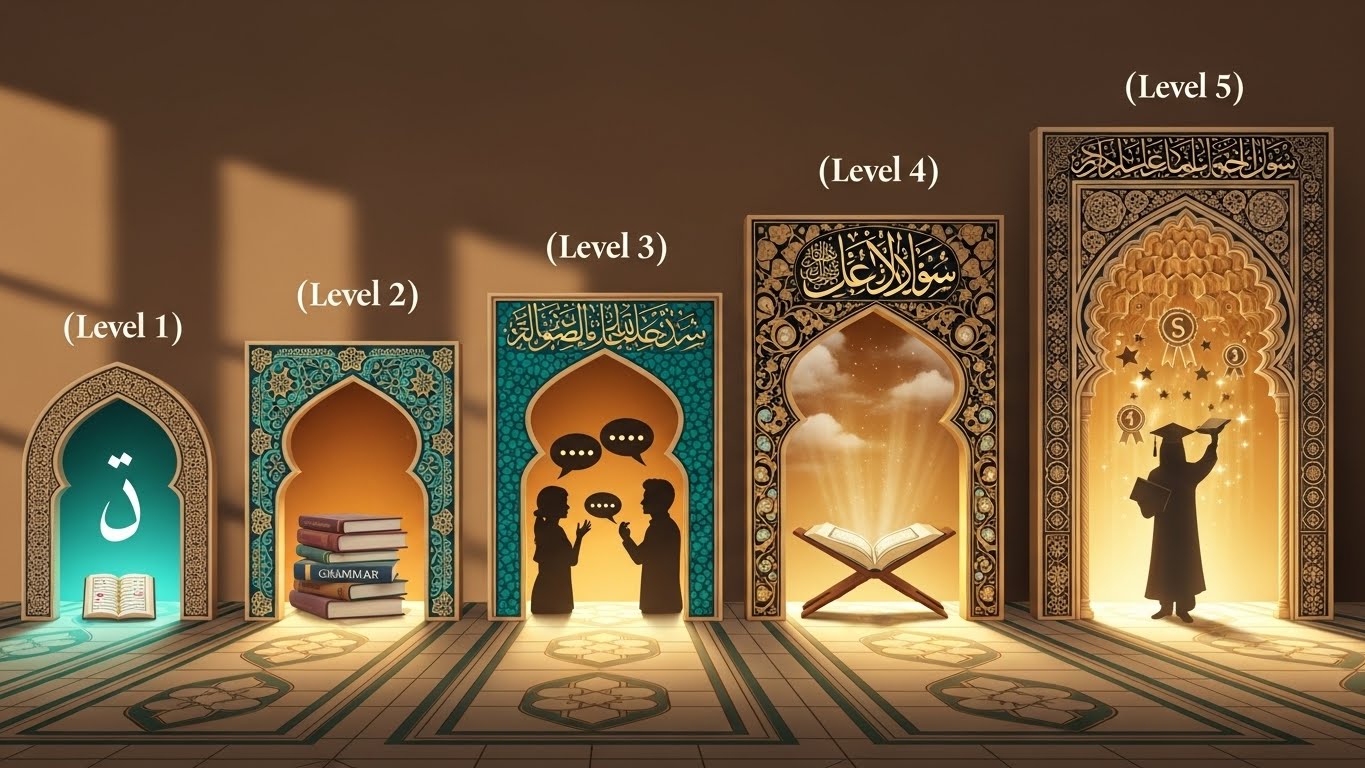
Clear Path from Beginner to Fluent Arabic Language
- Level 1: Mastering the Arabic Alphabet Master all 28 Arabic letters, their forms, and proper pronunciation. Learn to recognize and write letters in all positions. By the end, you'll read simple Arabic words and write basic sentences with confidence.
- Level 2: Essential Grammar & Vocabulary Build 500+ essential words while learning fundamental grammar. Master sentence construction, verb conjugations, and conversational phrases. This is where Arabic begins to "click" for most students.
- Level 3: Speaking with Confidence Develop true conversational ability with structured practice. Describe your daily life, express opinions, and understand native speakers. Master all verb tenses and expand to 1,500+ words.
- Level 4: Understanding Classical Texts Read authentic Arabic materials including news, classical literature, and religious texts. Strengthen advanced grammar and develop reading stamina. Many students begin understanding the Quran in its original language at this level.
- Level 5: Expressing Complex Ideas Achieve sophisticated Arabic expression with advanced grammar, idioms, and cultural nuances. Master formal Modern Standard Arabic and gain exposure to major dialects. Express complex ideas with precision and confidence.
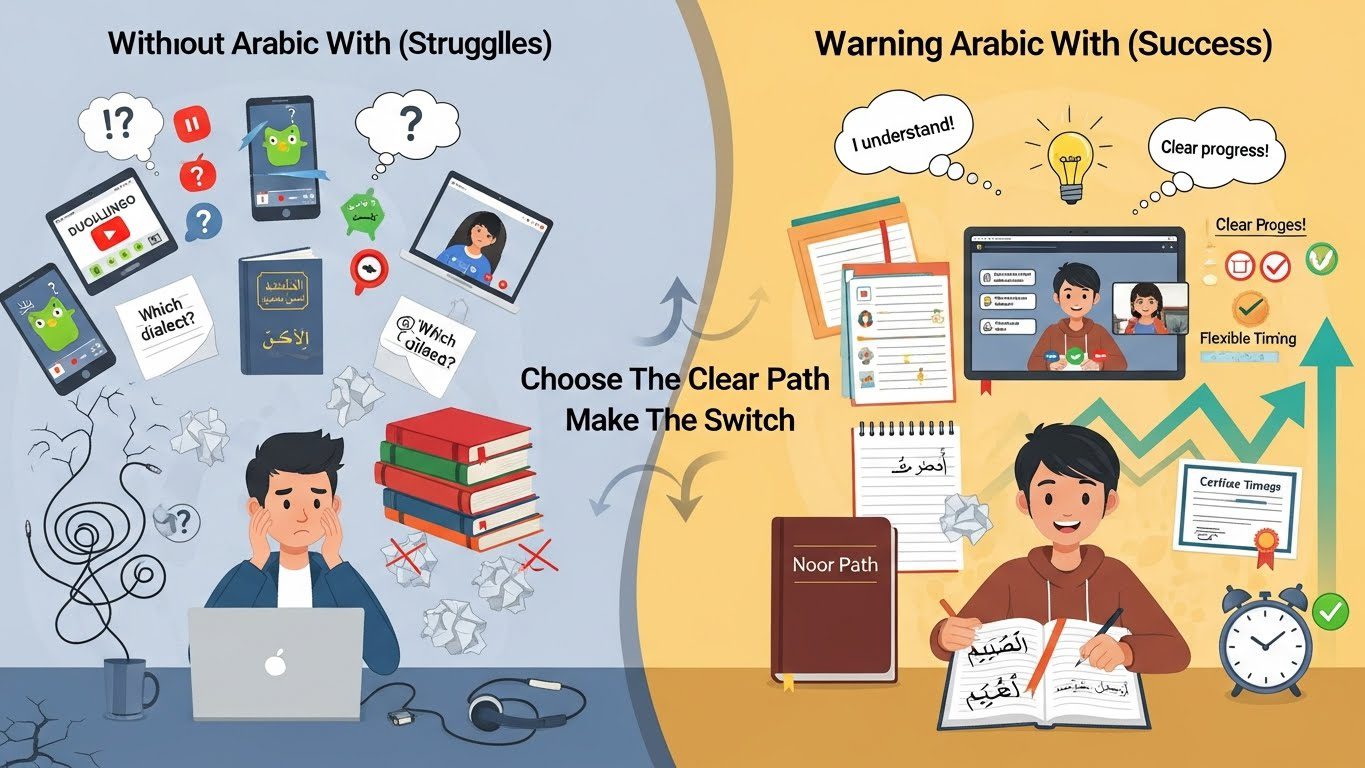
Why Most People Struggle to Learn Arabic (And Give Up Too Soon)
Learning Arabic should open doors to rich culture, deeper faith, and meaningful connections. But most learners hit the same frustrating roadblocks that make them quit before they see real progress.
It doesn’t have to be this way. Imagine having a personal Arabic tutor who understands exactly where you are, creates a custom path just for you, and meets you whenever your schedule allows. That’s the Noor Path difference.
Our Proven 3-Step Method to Arabic Fluency
Our proven methodology combines traditional Arabic teaching with modern learning science. Every lesson is live, personalized, and structured to build on what you’ve mastered.
Learn Arabic with Native Speakers Online — Why It Matters
There’s a meaningful difference between learning Arabic from an app, a pre-recorded video series, and arabic speaking practice with a live, qualified native tutor.
Native tutors bring three things that self-study tools structurally cannot:
- Accurate articulation modeling. Many Arabic letters (like ع, ح, ق, ض) have no equivalent sound in English and are produced from articulation points (makharij al-huruf) that are extremely difficult to self-correct from text or audio alone. A native speaker can hear your pronunciation in real time and adjust it before an incorrect habit sets in.
- Contextual, living usage. Native tutors don’t just teach vocabulary — they demonstrate how a word or grammatical structure is actually used in day-to-day speech, formal writing, or Qur’anic recitation, which a textbook or app cannot fully replicate.
- Real conversational feedback loops. True conversational ability only develops through back-and-forth interaction — being asked a question, formulating a response under light time pressure, and being corrected immediately. This is the core reason learn arabic with native speakers online consistently outperforms passive learning methods in building actual spoken fluency, not just recognition vocabulary.
When evaluating any online Arabic program, it’s worth asking specifically about tutor credentials — for Qur’anic Arabic in particular, look for tutors holding an Ijazah (a formal certification of qualification) in Tajweed or Qira’ah, or a background from a recognized Islamic institution, as this directly affects the accuracy of what you’re taught.
More Than Just Learning Word Your Complete Arabic Transformation
Inside Our Arabic Course Curriculum
Our comprehensive curriculum is designed for progressive mastery, each module builds logically on the previous one, ensuring solid foundations before advancing. Here’s exactly what you’ll learn:
Module 1 Foundations: Mastering the Arabic Alphabet
Perfect for: Complete beginners with no prior Arabic knowledge
Why it matters: Without mastering the alphabet, everything else becomes exponentially harder. This module ensures you start strong.
What You Will Learn:
- All 28 Arabic letters and their four forms (isolated, initial, medial, final)
- Proper pronunciation of each letter from the correct articulation points
- Short and long vowels (harakaat) and how they change word meanings
- Reading connected text from right to left with proper fluency
- Writing Arabic letters and words with correct stroke order
- Recognition of common letter combinations and patterns
Outcome: By completing this module, you’ll confidently read any Arabic word (even if you don’t understand it yet), write basic Arabic text, and have established the proper pronunciation habits that will serve your entire Arabic journey. This solid foundation prevents the pronunciation errors that plague most self-taught learners.
Module 2 Building Blocks: Secrets (Ahkam) of Recitation & Grammar Foundations
Perfect for: Students who can read Arabic but want to understand grammar
Why it matters: Grammar is the key that unlocks meaning. This module transforms you from someone who can read sounds into someone who understands sentences.
What You Will Learn:
- Noon Sakinah and Tanween rules (Idhaar, Iqlab, Idghaam, Ikhfa)
- Meem Sakinah rules and their practical application
- Essential Arabic sentence structure (Subject-Verb-Object patterns)
- Noun and verb identification and their different forms
- Gender rules and how they affect sentence construction
- Basic verb conjugations in present tense (I, you, he, she, we, they)
Outcome: You’ll understand how Arabic sentences are constructed, identify parts of speech instantly, and begin forming your own basic sentences. Your Quran reading will become more meaningful as you start recognizing grammatical patterns, and you’ll have the foundation needed for real communication.
Module 3 Intermediate Al-Noon: Secrets (Ahkam) & Conversation Skills
Perfect for: Intermediate learners ready for real-world conversation
Why it matters: This is where Arabic becomes practical—you transition from understanding to actually speaking and interacting.
What You Will Learn:
- Advanced Qalqalah rules for proper letter pronunciation
- Madd (elongation) rules and their six types
- Complete past tense verb conjugations and usage
- Future tense formation and when to use it
- Vocabulary expansion: 500+ essential words for daily life
- Conversational phrases for common situations (greetings, shopping, directions, etc.)
Outcome: You’ll be able to have basic conversations in Arabic, understand simple spoken dialogue at moderate speed, and express yourself in past, present, and future tenses. Your Quranic recitation will sound significantly more polished, and you’ll start consuming basic Arabic content (children’s books, simple news) with understanding.
Module 4: Advanced Tajweed Rules & Reading Comprehension
Perfect for: Advanced learners seeking native-like fluency
Why it matters: This final module refines your skills to near-native proficiency, allowing sophisticated expression and cultural fluency.
What You Will Learn:
- Complete Tajweed Stitharah rules for perfect recitation
- Advanced idioms, expressions, and cultural nuances
- Sophisticated debate and persuasion techniques in Arabic
- Dialect awareness (Egyptian, Levantine, Gulf) and when to use them
- Analysis of complex literary and academic texts
- Professional and academic writing in formal Arabic
Outcome: You’ll achieve sophisticated Arabic fluency capable of professional or academic use, understand Arabic media and literature naturally, express complex ideas with nuance and precision, and possess the confidence to navigate any Arabic-speaking environment. Many students at this level serve as interpreters, teach Arabic themselves, or pursue advanced Islamic studies.
Module 5: Practical Applications (Stitharah) & Advanced Fluency
(Completing the narrative and understanding the eternal impact)
What You Will Learn:
- The peaceful conquest of Mecca: mercy in victory and forgiveness of enemies
- Battles of Hunayn and Tabuk: final military expeditions
- The Farewell Pilgrimage and the Last Sermon: completion of the religion
- The Prophet’s final days, illness, and passing to the highest companionship
- The legacy: how his life continues to inspire and guide humanity
You will understand the completion of the Prophet’s mission and how to carry his message forward.
Which Arabic Should You Learn? MSA, Quranic Arabic & Dialects Explained
One of the most common points of confusion for new students is understanding that “Arabic” is not a single, uniform language — it’s a family of related registers, and knowing which one you need will shape your entire learning path.
Modern Standard Arabic (Fus’ha) is the standardized form used in news media, formal writing, books, and official communication across the Arab world. It’s the version most online arabic language course for beginners programs start with, because it gives you a foundation that’s understood everywhere from Morocco to Iraq.
Quranic (Classical) Arabic is the Arabic of the Qur’an and classical Islamic texts. It shares its grammar and much of its vocabulary with Modern Standard Arabic, but recitation also requires Tajweed — the set of rules governing correct pronunciation and articulation of Qur’anic letters. Someone learning primarily to understand the Qur’an and Salah will want a curriculum, like this one, that blends grammar fundamentals with Tajweed application rather than pure conversational drilling.
Spoken dialects (Ammiyah) — Egyptian, Levantine, Gulf, Maghrebi, and others — are the everyday languages people actually speak at home and in the street. They can differ from MSA and from each other enough that a fluent MSA speaker may still need adjustment time to follow casual conversation in a specific region.
A well-structured course doesn’t force you to choose one and abandon the others — it builds MSA and Quranic Arabic as your foundation (since dialects branch from these), then introduces dialect awareness once you’re conversationally confident, which is exactly how this course’s Level 4–5 progression is designed.
Key Arabic & Islamic Terms You’ll Learn (Glossary)
Understanding these terms upfront will help you follow your course curriculum and track your own progress:
- Tajweed (تجويد): The set of rules governing the correct pronunciation and articulation of letters when reciting the Qur’an, including elongation, nasalization, and merging rules.
- Ahkam (أحكام): Literally “rulings” — used in this context to refer to the specific pronunciation rules (like Noon Sakinah and Meem Sakinah rules) that govern Qur’anic recitation.
- Makharij al-Huruf (مخارج الحروف): The precise articulation points in the mouth and throat from which each Arabic letter is produced.
- Harakaat (حركات): The short vowel marks (Fatha, Dammah, Kasrah) placed above or below letters that indicate short vowel sounds.
- Tanween (تنوين): Nunation — a doubled vowel mark at the end of a noun that adds an “n” sound, affecting grammar and pronunciation.
- Fus’ha (فصحى): Formal, standardized Arabic — encompassing both Modern Standard Arabic and Classical/Qur’anic Arabic.
- Ammiyah (عامية): Colloquial, spoken dialect Arabic, which varies by region.
Learn from Certified Native Arabic Tutors
Why Choose Noor Path for Your Arabic Course?
- Live 1-on-1 Lessons with Native Experts
- Structured Curriculum with Clear Progression
- Flexible Scheduling That Fits Your Life
- Both Modern Standard & Quranic Arabic
- Proven Track Record: 10,000+ Success Stories
- Affordable Excellence
- Live 1-on-1 Lessons with Native Experts — Every lesson is fully focused on you; no shared class time, no waiting your turn to speak.
- Structured Curriculum with Clear Progression — Each of the 5 levels builds directly on the last, so you always know what you’re learning and why.
- Flexible Scheduling That Fits Your Life — Book lessons around your existing commitments instead of adjusting your life around a fixed class time.
- Both Modern Standard & Quranic Arabic — One curriculum path covers formal Arabic and Qur’anic understanding, so you’re not piecing together separate resources.
- Affordable Excellence — Personalized native-tutor instruction without the overhead of in-person institute fees.
Student Testimonial
Frequently Asked Questions About Our Online Arabic Course
Do I need any prior knowledge to start learning Arabic?
Absolutely not! Our Arabic course is designed for complete beginners with zero prior knowledge. We start from the basics—the Arabic alphabet and proper pronunciation—and build systematically. Our personalized assessment ensures your learning plan matches your current level perfectly.
How is learning Arabic online different from in-person classes?
Online learning with Noor Path offers major advantages: exclusive one-on-one attention, flexible scheduling, access to the best tutors regardless of location, and the ability to record lessons for review. Every minute is focused entirely on you—your questions, your mistakes, your needs. Most students progress significantly faster online than in crowded classrooms.
How long does it take to become fluent in Arabic?
With consistent study (2-3 lessons per week plus daily practice), expect to: read Arabic fluently within 2-3 months, hold basic conversations within 4-6 months, and achieve intermediate proficiency within a year. Advanced fluency requires 2-3 years of consistent study. Arabic isn’t mastered overnight, but with the right method, it’s absolutely achievable.
Is this course suitable for children?
Yes! We have specialized tutors experienced in teaching children as young as 5 years old. Children’s lessons are more interactive, game-based, and shorter to match attention spans. We recommend 20-30 minute sessions for younger children (ages 5-9) and 45-60 minute sessions for older children and teens.
Is the certificate from this course recognized for academic or professional purposes?
The certificate of completion documents your progress through each structured level and can support language-learning portfolios, personal records, or informal use. If you need Arabic proficiency for a specific academic program, employer, or immigration requirement, check with that institution directly about which certifications or standardized tests (such as ALPT or a university placement exam) they specifically require, since requirements vary widely by institution.
Do I need to be Muslim to take this course?
No. The course is structured to serve both learners focused on Modern Standard Arabic for general, cultural, or professional purposes, and learners specifically wanting to understand the Qur’an and Salah. Non-Muslim students are welcome, and the conversational and grammar-focused tracks can be emphasized over the Qur’anic components if that better fits your goals — this is worth discussing with your tutor during your free trial.
Should I focus on Modern Standard Arabic or a spoken dialect?
If your priority is reading the Qur’an, religious texts, news media, or formal writing, Modern Standard Arabic (and Quranic Arabic specifically, if your focus is worship and recitation) is the right starting point. If your priority is speaking casually with family or friends from a specific region, your tutor can incorporate relevant dialect exposure alongside your MSA foundation — this is typically introduced from Level 3 onward once basic fluency is established.
What happens after the free trial class?
The free trial is a live 1-on-1 session used to assess your current level, discuss your goals, and let you experience the teaching style before committing to a paid plan. No credit card is required to book it, and there’s no obligation to continue afterward.
What do I need technically to join a lesson?
A stable internet connection, a computer, tablet, or smartphone with a camera and microphone, and a video-calling platform (details are provided at enrollment). Lessons are conducted live and can typically be recorded for your own review afterward.
Our 100% Satisfaction Promise
If you are not happy after your first week of paid classes, we will refund your money with no questions asked.
Give Your Arabic Learning the Excellence It Deserves