✦ Hadith – Course Details
Online Hadith Course for Beginners | 1-on-1 with Al-Azhar Scholars – NoorPath
Dive deep into the traditions, sayings, and teachings of Prophet Muhammad (PBUH) with our comprehensive online Hadith course. Learn 1-on-1 with expert, Al-Azhar certified scholars to understand the context, authenticity, and practical application of the Sunnah in your daily life.
- Flexible scheduling (study the Sunnah at your own pace)
- Certified Al-Azhar tutors with fluent English
- In-depth study of major compilations (Nawawi's 40 Hadith, Sahih Al-Bukhari, etc.)
No credit card required

500+
Students
Avg Rating
Certified
What Is the Meaning of Hadith? (A Beginner’s Definition)
If you’re new to Islamic studies, the meaning of the hadith is one of the first things worth understanding clearly. In Arabic, Hadith (الحديث) literally means “speech,” “report,” or “narration.” In Islamic terminology, it refers to the recorded sayings, actions, approvals, and physical or moral qualities of Prophet Muhammad ﷺ, as transmitted by his Companions and preserved through a documented chain of narrators.
Every Hadith has two parts:
Sanad (chain of narration): the list of narrators who transmitted the report from one generation to the next, back to the Prophet ﷺ.
Matn (text): the actual content — what was said or done.
Scholars distinguish Hadith from two related terms:
Sunnah — the broader concept of the Prophet’s ﷺ example and way of life, of which Hadith are the textual record.
Athar — a report attributed to a Companion or a Successor (Tabi’i) rather than to the Prophet ﷺ himself.
Understanding this distinction is the starting point of any serious study of Hadith sciences, and it’s exactly where our beginner-level Module 1 begins.
Hadith vs. Sunnah vs. Quran — How Do They Relate?
A common question for anyone reading about hadith for the first time is how it relates to the Quran. In Sunni Islamic scholarship, the Quran is the primary source of guidance, and authentic Hadith form the second source — explaining, detailing, and sometimes specifying rulings that the Quran states in general terms. For example, the Quran commands prayer (Salah), while the Hadith literature preserves the Prophet’s ﷺ detailed instructions on how to perform it.
This is why classical scholars treated Hadith authentication with such rigor: because acting on a fabricated or unreliable narration in the name of the Prophet ﷺ carries serious consequences, both scholars of Hadith and of Fiqh developed independent verification methods rather than accepting every reported narration at face value.
Key Hadith Terms Every Beginner Should Know
A short glossary to help you follow along as you study:
- Sanad — the chain of narrators connecting a Hadith back to the Prophet ﷺ.
- Matn — the actual wording or content of the Hadith.
- Rawi — a narrator within the chain.
- Isnad — the act of attributing a Hadith to its chain of transmission (often used interchangeably with Sanad).
- Thiqa — a narrator graded as trustworthy and precise.
- Da’if — “weak”; a Hadith with a break or weakness in its chain or a flaw in its narrators.
- Ijazah — a formal scholarly authorization certifying that a student has studied a text or science directly under a qualified teacher, with a connected chain back to earlier scholars.
What Students Say About Our Hadith Course

How do you know if a Hadith is authentic?
Learn the science behind Hadith authentication
How Muslim scholars preserved the Sunnah through rigorous verification systems.
Understand authentic, weak, and fabricated Hadith
How Hadith are classified and why some narrations are accepted while others are rejected.
Study the methodology of classical scholars
How scholars examined narrators, chains of transmission, and evidence for authenticity.
Apply Hadith knowledge to everyday life
Verify what you read, understand the Sunnah correctly, and apply authentic teachings.
Course overview
Hadith Course
- 500+ students enrolled worldwide
- Serving 42+ countries - UK, USA, Canada & more
- Certificate of completion included
- 5.0 rating on Trustpilot
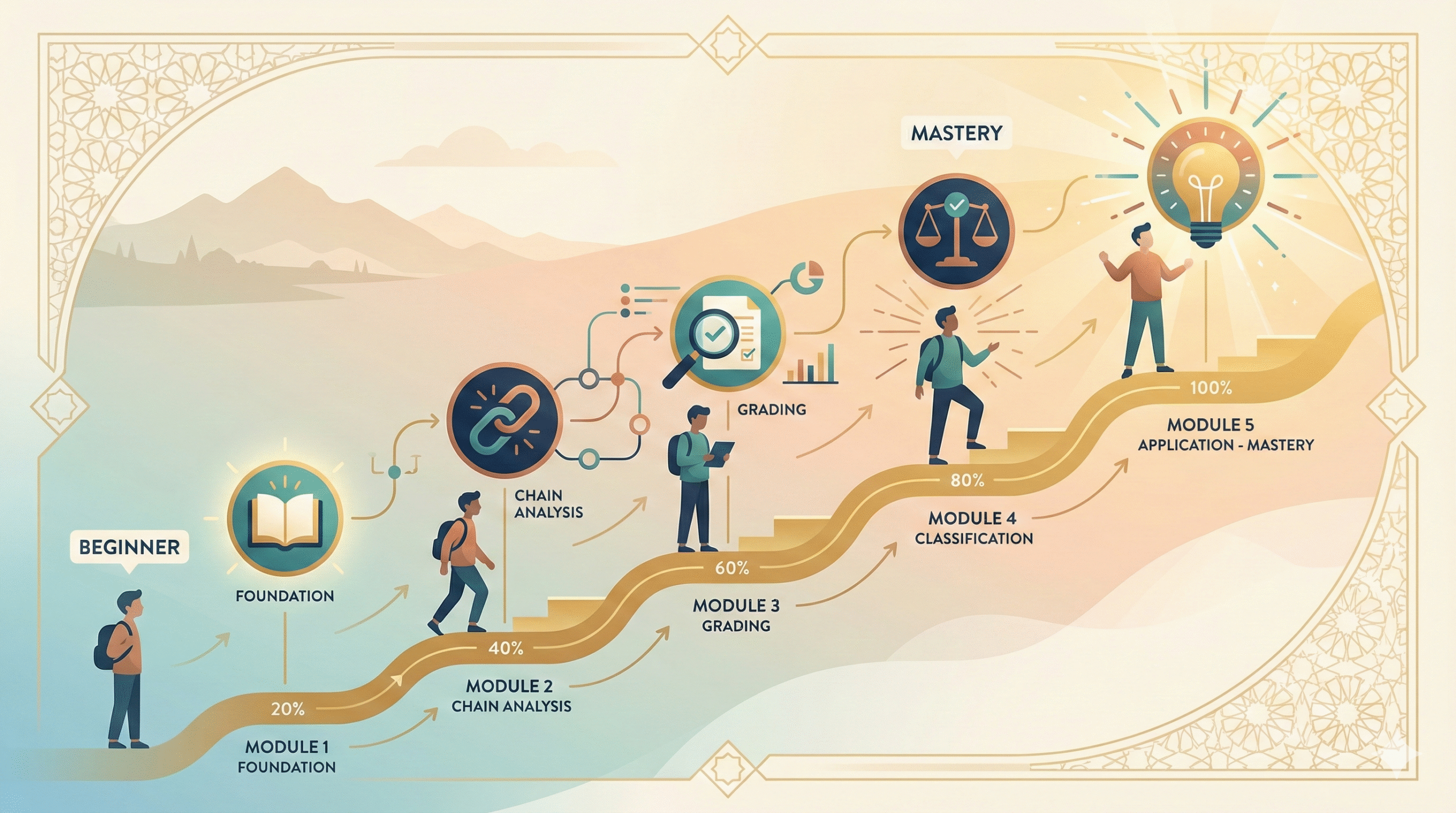
Your 5-Module Journey Complete Hadith Sciences Mastery
- Level 1: Introduction to Hadith Sciences Start with essential terminology and concepts. Learn the definition of Hadith, Sunnah, and Athar. Understand the structure of a Hadith (Sanad and Matn) and why authentication matters for Islamic practice.
- Level 2: The Prophetic Sources Major Hadith Collections Discover the Six Authentic Books (Kutub al-Sittah) including Bukhari and Muslim. Learn about their compilers, methodologies, and why certain collections are ranked higher than others in scholarly tradition.
- Level 3: Authentication Science Narrator Criticism & Chain Analysis Master the science of Ilm al-Rijal. evaluating narrator reliability, memory, character, and accuracy. Learn to trace chains of narration (Sanad) and identify strong versus weak links in transmission.
- Level 4: Grading & Classification Understanding Hadith Categories Learn the comprehensive grading system: Sahih (authentic), Hasan (good), Da'if (weak), Mawdu (fabricated), and their sub-categories. Understand when each grade is acceptable for practice versus not.
- Level 5: Practical Application Living the Prophetic Guidance Apply authenticated Hadith to real-life scenarios worship, business ethics, family relationships, and personal development. Learn to distinguish cultural practices from authentic Sunnah and resolve apparent contradictions between narrations.
Struggling to Verify Authentic Hadith in the Age of Misinformation?
Living in the West offers opportunities, but finding quality Islamic education is a struggle. Many students want to learn Hadith sciences but face these common barriers.
You don’t need more time. You need a better system. Noor Path fits your life, not the other way around.
Why Choose NoorPath for Your Hadith Course? (Our Methodology)
There’s no shortage of hadith courses for beginners online, but structure and teacher quality make the real difference. At Noor Hadith — NoorPath’s Hadith learning track — every session is built around three principles:
- One-on-one, not group-paced. Your tutor adjusts explanations, pacing, and examples to your actual level, rather than teaching to the middle of a class.
- Scholarly grounding, not summaries. Lessons are built on the classical Mustalah al-Hadith curriculum — the same framework taught in institutions like Al-Azhar — rather than simplified secondhand summaries.
- Applied practice. You don’t just hear about chain analysis (Isnad evaluation) and narrator criticism (Ilm al-Rijal) — you practice grading sample chains with your tutor, so the skill actually transfers.
This is what separates a structured hadith course from independent reading: you get correction, context, and a verified teacher-to-student connection (Ijazah), the same way this science has been transmitted for over a thousand years.
What You'll Achieve From Hadith Beginner to Confident Authenticator
Inside Our Hadith Course Comprehensive Curriculum
Module 1: The Foundation Mastering the Hadith Basics
(Ideal for complete beginners or anyone wanting solid fundamentals)
We start from the absolute beginning. You’ll understand what Hadith are, why they’re essential to Islam, and the fascinating history of how they were preserved across 1400 years.
What You Will Learn:
- Clear definitions: Hadith vs. Sunnah vs. Athar and their roles in Islamic law
- The structure of a Hadith: Sanad (chain of narration) and Matn (text content)
- Historical preservation: How companions memorized, wrote, and transmitted Prophetic teachings
- The compilation era: Why scholars like Bukhari and Muslim traveled thousands of miles collecting Hadith
- Motivation and importance: Why are authentic Hadith your second source of guidance after Quran
You will understand the critical role Hadith play in Islamic practice and why authentication matters.
Module 2: The Prophetic Sources Major Hadith Collections & Their Scholars
(Building comprehensive knowledge of primary sources)
What You Will Learn:
- The Six Authentic Books (Kutub al-Sittah): Bukhari, Muslim, Abu Dawud, Tirmidhi, Nasa’i, Ibn Majah
- Ranking and reliability: Why Bukhari and Muslim are considered most authentic
- Biography of major compilers: Their lives, journeys, methodologies, and scholarly standards
- Other important collections: Musnad Ahmad, Muwatta Malik, and specialized compilations
- How to navigate Hadith books: Chapter organization, numbering systems, and finding narrations
You will be familiar with the major Hadith sources and know which collections to reference for different purposes.
Module 3: Authentication Science The Rules of Narrator Criticism
(Mastering the science that distinguishes authentic from fabricated)
What You Will Learn:
- Ilm al-Rijal (Science of Men): The sophisticated biographical system scholars developed
- Five conditions of narrator authenticity: Muslim, mature, sane, just (‘Adalah), and precise (Dabt)
- Tabaqat (narrator generations): Understanding transmission layers from companions to later scholars
- Narrator criticism terminology: Thiqa (reliable), Da’if (weak), Matruk (abandoned), and dozens more grades
- Practical chain analysis: Step-by-step methodology to evaluate a Sanad’s strength
You will be able to analyze narrator chains and understand why scholars grade certain Hadith as authentic or weak.
Module 4: Grading & Classification Understanding Hadith Categories
(Comprehensive system of Hadith authentication and classification)
What You Will Learn:
- The three main grades: Sahih (authentic), Hasan (good), and Da’if (weak) with detailed criteria
- Sub-categories and nuances: Sahih li-dhatihi vs. Sahih li-ghayrihi, strengthening through multiple chains
- Fabricated Hadith (Mawdu): How to identify forgeries and why they emerged
- Types by transmission: Mutawatir (mass-transmitted), Ahad (singular), Mashhur (famous)
- Special categories: Hadith Qudsi (Divine narrations), Mu’allaq (suspended), and Mursal (missing companion)
You will confidently identify Hadith grades and know when narrations are acceptable for religious practice.
Module 5: Practical Application Living by Authentic Prophetic Guidance
(Bringing scholarship into real life)
What You Will Learn:
- Contextual understanding: Historical circumstances (Asbab al-Wurud) and their impact on interpretation
- Reconciling apparent contradictions between Hadith using classical scholarly methods
- Distinguishing Sunnah from culture: What’s universally binding vs. time-specific or cultural
- Modern application frameworks: Business ethics, family life, worship, and personal development
- Red flags to avoid: Common mistakes in Hadith interpretation and how to prevent them
You will apply authenticated Prophetic teachings to your daily life with wisdom, confidence, and scholarly precision.
Sunan, Musnad, and Musannaf — Understanding How Hadith Books Are Organized
Beyond grading (Sahih, Hasan, Da’if), classical Hadith collections are also classified by how they’re arranged:
- Sahih collections, like those of Bukhari and Muslim, contain only Hadith the compiler judged to be authentic, organized by subject/chapter (Fiqh-based order).
- Sunan collections, like those of Abu Dawud, Tirmidhi, Nasa’i, and Ibn Majah, are also arranged by subject/chapter but include a mix of authentic, good, and weaker narrations, usually with the compiler’s own notes on grading.
- Musnad collections, like Musnad Ahmad, are arranged by narrator (i.e., by which Companion reported the Hadith) rather than by topic.
- Musannaf collections, like Musannaf Ibn Abi Shaybah, are broad compilations arranged by subject that include Hadith, statements of Companions, and legal opinions together.
Knowing this arrangement logic makes it far easier to navigate any Hadith book once you move beyond the beginner level — a skill covered hands-on in Module 2 of our course.
Learn from Certified Hadith Experts
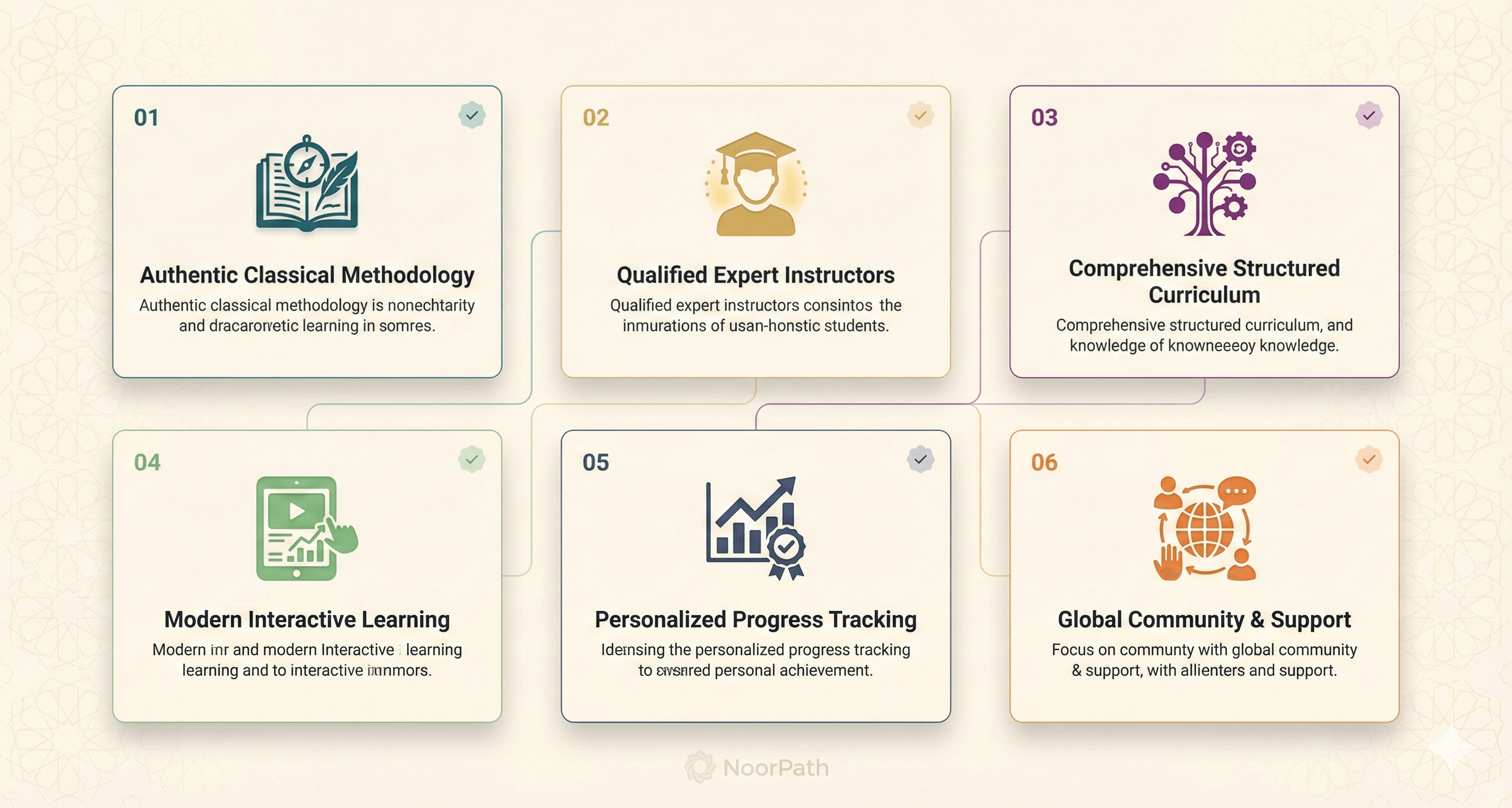
6 Reasons NoorPath Offers the Best Online Hadith Course
- Learn authentic classical Hadith sciences (Mustalahal Hadith, Ilm al-Rijal) taught in Islamic universities, delivered in modern accessible format.
- Study from verified sources including Sahih Bukhari, Sahih Muslim, and the Six Authentic Books with deep scholarly context.
- Gain practical authentication skills through hands-on chain analysis, narrator evaluation, and Hadith grading exercises.
- Apply seventh-century Prophetic wisdom to modern life with proven contextual frameworks and application strategies.
- Study with certified scholars holding Ijazah (traditional authorization) and connected chains of narration from recognized institutions.
Student Testimonial
Common Questions About Learning Hadith Course Online
What makes this hadith course different from reading Hadith books myself?
While self-study is valuable, our structured hadith course provides systematic training in Hadith sciences authentication methodology, narrator criticism, chain analysis, and practical application frameworks you won’t get from just reading collections. You’ll learn the “why” and “how” behind Hadith grading with expert guidance.
Do I need Arabic knowledge to take this hadith course?
No. While Arabic knowledge enhances your learning, our course is designed for English speakers. We teach essential Arabic terminology in context, provide transliteration, and focus on understanding Hadith sciences and application rather than requiring fluency.
Will this course teach me to memorize Hadith?
While we encourage memorization, our primary focus is understanding Hadith sciences. authentication, narrator criticism, grading systems, and practical application. We believe comprehension and verification skills are more valuable than memorization without understanding.
How long does the hadith course take to complete?
The comprehensive curriculum typically takes 8-12 months to complete thoroughly, but you have lifetime access. Many students complete faster by dedicating more hours weekly, while others take longer. you progress at your own pace.
What is the meaning of Hadith in Islam?
Hadith refers to the recorded sayings, actions, and approvals of Prophet Muhammad ﷺ, transmitted through a documented chain of narrators (Sanad) and preserved as the second primary source of Islamic guidance after the Quran.
What is the difference between Hadith and Sunnah?
Sunnah is the broader concept of the Prophet’s ﷺ entire example and way of life. Hadith are the specific textual reports — the recorded narrations — through which that Sunnah has been preserved and transmitted to us.
Is Hadith as important as the Quran?
The Quran and authentic Hadith are not treated as equal in origin — the Quran is the direct, literal revealed word of Allah, while Hadith are the Prophet’s ﷺ own words and actions, preserved by his Companions. Even so, mainstream Sunni scholarship treats authentic Hadith as the indispensable second source of Islamic law and practice, since much of how the Quran is applied — how to pray, fast, or handle daily affairs — comes directly from the Sunnah.
Do I need prior knowledge to join hadith courses for beginners at NoorPath?
No. Our beginner track (Module 1) assumes no prior background. You’ll start with basic definitions — Hadith, Sunnah, Athar, Sanad, and Matn — before moving into authentication science.
What makes NoorPath's Hadith course different from other online options?
One-on-one sessions with Al-Azhar certified, Ijazah-holding tutors, a curriculum based on classical Mustalah al-Hadith rather than simplified summaries, and hands-on chain-analysis practice rather than passive lecture-style teaching.
Our 100% Satisfaction Promise
If you are not happy after your first week of paid classes, we will refund your money with no questions asked.
Ready to Master Authentic Hadith Sciences?